
Capturing Every Angle: A Definitive Battle Between 360 Cameras
Comparing the Physical Attributes and Durability of the DJI Osmo 360 and Insta360 X5
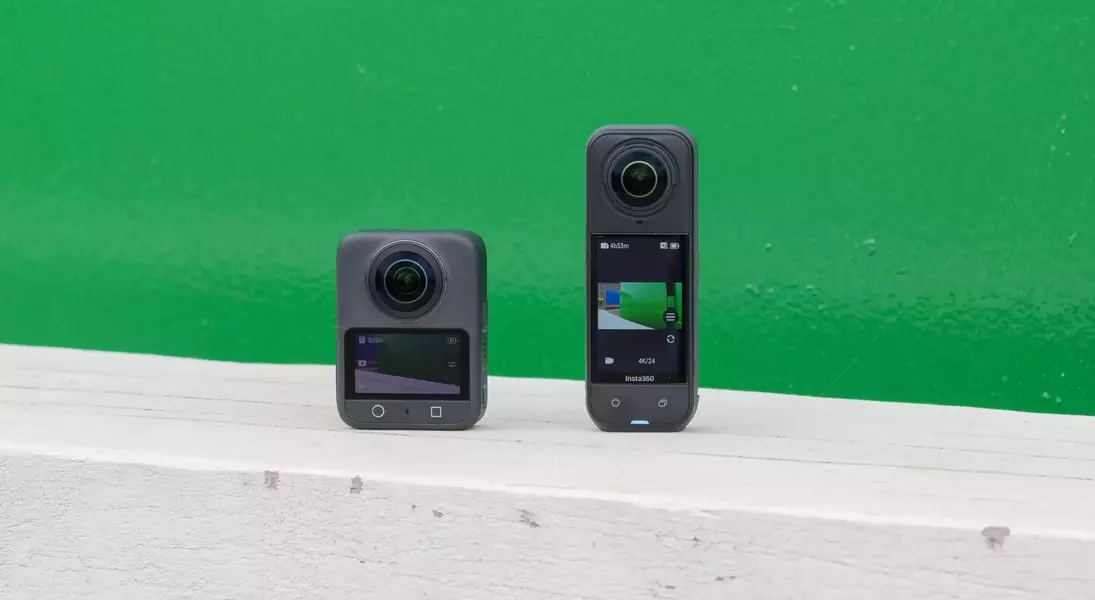
Both the DJI Osmo 360 and Insta360 X5 share a remarkably similar aesthetic: compact, pocket-friendly, and sleekly designed in dark grey. Each device is equipped with a modest touchscreen, essential physical buttons, and versatile mounting options, alongside their distinctive dual-lens setup. The most noticeable physical difference lies in their form factor: the Osmo 360 is broader and more squared, contrasting with the X5's elongated, candy-bar shape. Both cameras boast an IP68 rating, signifying their resilience against dust and water immersion. However, their water resistance varies, with the X5 capable of descending to 15 meters compared to the Osmo 360's 10 meters. A crucial distinction is the X5's user-replaceable lenses, offering a significant advantage in repairability over the Osmo 360, whose lenses are permanently affixed. While protective covers are available for both, they are arguably more crucial for the DJI Osmo 360 due to its non-replaceable lenses.
Examining the Operational Efficiency and User Experience
In terms of connectivity, both cameras facilitate rapid data transfers via USB-C 3.0. The DJI Osmo 360 holds a slight edge in wireless transfer speeds, thanks to its Wi-Fi 6 support, surpassing the X5's Wi-Fi 5. Despite this, real-world usage reveals minimal noticeable differences in speed. Battery performance is surprisingly consistent between the two, despite the X5 having a larger capacity battery. Both cameras demonstrated similar endurance in controlled tests, recording nearly identical durations of 8K video before their storage was full. User interfaces on both devices are highly intuitive, featuring responsive touchscreens and easy-to-navigate menus, ensuring a smooth operational experience without a clear winner in this category. A significant advantage for the Osmo 360 is its integrated 128GB storage, providing immediate recording capabilities out of the box, unlike the X5 which relies solely on external microSD cards.
Evaluating the Visual Output Quality
On paper, the DJI Osmo 360 appears superior in image quality due to its larger sensors, bigger pixels, and 10-bit video capability, compared to the Insta360 X5's 8-bit output. However, practical tests reveal a near-identical visual performance. Discerning observers might find subtle differences, but for most users, the distinction in captured video is negligible. Some may even prefer the X5's punchier low-light footage. Both cameras support log video capture, which benefits professional color graders by allowing greater flexibility in post-production. For the average user who prefers minimal post-processing, both cameras deliver comparable, high-quality results.
Assessing Audio Recording Capabilities
Both cameras record audio at 16-bit quality using their internal microphones, and offer various modes to enhance sound. However, for superior audio capture, especially outdoors, an external microphone is highly recommended, as both cameras' built-in mics are prone to wind noise. The DJI Osmo 360 marginally outperforms the Insta360 X5 in wind noise reduction. Crucially, both cameras are compatible with their respective brands' wireless microphone systems, such as the Insta360 Mic Air for the X5 and the DJI Mic Mini or Mic 2 for the Osmo 360. These external accessories significantly improve audio quality, making them essential for vlogging or outdoor recording.
Exploring the Functionality of Companion Applications
The core appeal of 360-degree cameras lies in their post-capture re-framing capabilities, which rely heavily on sophisticated editing applications. Both DJI and Insta360 provide comprehensive mobile and desktop applications. Insta360, with its extensive experience in the 360-camera market, offers a more refined and user-friendly app ecosystem. Its mobile app, particularly its AI-assisted editing features, excels at generating polished short videos with dynamic highlights and music. DJI's Mimo mobile app, while still developing, offers robust manual editing tools comparable to Insta360's, though its automated editing is less consistent. The DJI Studio desktop app, despite being newer, provides an intuitive and effective platform for video editing and export. Overall, Insta360's companion applications currently offer a more mature and feature-rich experience.
Concluding Thoughts on the Two Leading 360-Degree Cameras
Both the DJI Osmo 360 and Insta360 X5 are exceptional 360-degree cameras, each offering compelling features that justify their price. Deciding between them depends largely on individual priorities and existing equipment ecosystems. While the Osmo 360 boasts impressive sensor specifications, the Insta360 X5 often matches its image quality in real-world scenarios and surpasses it in automated editing capabilities. The X5's robust design and easily replaceable lenses make it the more durable and adventure-ready option. Conversely, the Osmo 360's integrated storage and compatibility with DJI's microphone and battery systems make it a strong contender for users already invested in the DJI ecosystem. Both cameras excel in user-friendliness and battery efficiency. Ultimately, an existing Insta360 X5 owner would find little compelling reason to switch to the Osmo 360, despite its technical advancements, highlighting the X5's enduring appeal in the competitive 360-camera market.