
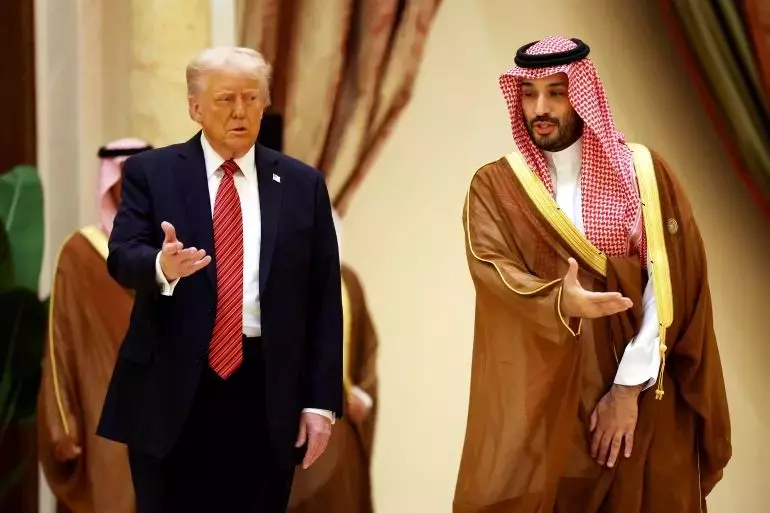
A recently approved pact between the United States and Saudi Arabia permits the latter to develop a civilian nuclear program, including the capacity for uranium enrichment on its own territory. This move signifies a notable departure from long-standing American non-proliferation principles, according to various media reports.
Sources familiar with these discussions, as reported by The Wall Street Journal and The New York Times, indicate that the former US President is anticipated to seek congressional approval for this accord. Such an agreement could facilitate the involvement of American firms, like Westinghouse, in establishing Saudi Arabia's nuclear infrastructure. This timing is particularly sensitive, as the US has cited preventing Iran from developing nuclear weapons as a primary objective of its military efforts. Critics argue that enabling Saudi Arabia to enrich uranium, even for peaceful purposes, could undermine this stance, with some observers expressing apprehension about the potential misuse of enriched nuclear material.
This initiative holds substantial importance. Saudi Arabia has long pursued a civilian nuclear program as a strategy to diversify its economy and lessen its reliance on oil. Negotiations regarding US nuclear collaboration have spanned multiple administrations. While previous talks under a different administration linked this cooperation to broader agreements, including Saudi recognition of Israel, the current administration has reportedly decoupled these requirements. A framework for civilian nuclear cooperation, aimed at a long-term partnership adhering to non-proliferation standards, was established last year during a visit by the Saudi Crown Prince to the US.
The agreement, spanning 30 years, would reportedly authorize American companies, such as Pittsburgh-based Westinghouse, to assist in the development of Saudi Arabia's civilian nuclear sector. A key provision would allow Saudi Arabia to undertake domestic uranium enrichment after a joint US-Saudi assessment. While uranium enrichment is not inherently unlawful and is essential for nuclear power plant fuel, the same technology can be adapted to produce highly enriched uranium for nuclear weapons. Saudi Arabia has previously indicated its intent to pursue nuclear weapons if Iran acquires them, despite Tehran's insistence that its nuclear program is peaceful.
Concerns among experts stem from the reported agreement potentially not meeting the stringent non-proliferation standards applied to other US partners. For instance, the UAE's 2009 "123 Agreement" prohibited uranium enrichment and spent nuclear fuel reprocessing—a benchmark for non-proliferation. Conversely, the proposed Saudi deal might permit enrichment and could forgo the International Atomic Energy Agency's Additional Protocol, which grants inspectors enhanced authority to monitor nuclear material. Geopolitical analysts like Michael Horowitz view this as a "very consequential" agreement, suggesting that it might allow Saudi Arabia a pathway toward a nuclear program not solely civilian, even if safeguards are in place, as these depend heavily on the bilateral relationship between the US and Saudi Arabia.
The US rationale for this agreement centers on reinforcing its influence in the Gulf region. A report to Congress by the previous US administration suggested that expanded civilian nuclear cooperation would sustain American leadership in the global nuclear industry and prevent rival powers from increasing their sway in the kingdom. The administration also argued that Saudi Arabia's growing electricity needs necessitate nuclear energy as a crucial component of its long-term energy strategy, notwithstanding its extensive oil reserves and suitable conditions for solar power.
Congressional approval is mandatory for any civilian nuclear cooperation agreement, with Congress having the authority to review and reject such "123 agreements." Overriding a presidential veto would require a two-thirds majority in Congress. The proposal is expected to undergo significant scrutiny from lawmakers across the political spectrum, particularly concerning the safeguards for Saudi uranium enrichment. Some members of Congress and Israeli officials fear that permitting enrichment could, in the future, enable Saudi Arabia to develop nuclear weapons, even if the program initially serves civilian purposes. Experts like Andrea Stricker, from the Foundation for Defense of Democracies' Nonproliferation Program, have urged Congress to reject the proposed agreement, expressing hope that a future administration might reverse the policy to prevent the erosion of safeguards and the establishment of negative precedents for other nations.